
How to Build Backlinks for a New B2B Website (A Practical, Spam-Free Approach)
Google has maintained the importance of backlinks and the authority that comes with a natural backlink profile. B2B businesses often have a hard time building quality backlinks, and buying links from link farms is open to receiving penalties from Google. This is why we’ve created this practical and spam-free guide to B2B link building in 2026.
What This Guide Actually Covers
B2B Link building requires a lot of time, effort, and strategic planning. B2B businesses especially need tons of quality links as they face fierce competition. Without backlinks, most B2B websites will struggle to compete on commercially meaningful keywords, regardless of content quality.
In this B2B backlinking guide, we’ll cover:
- Why Backlinks Matter for B2B (and Why Most Advice Fails)
- The Backlink Reality Check: When You Shouldn’t Build Links
- A Framework for Ethical, Sustainable B2B Backlink Building
- 8 Link Building Tactics That Work for B2B
- What to Avoid While Building Backlinks?
- How to Evaluate Backlink Quality?
- How to Measure Impact
- Integrating Backlinks Into Your Broader SEO System
- FAQs
Why Backlinks Matter for B2B (and Why Most Advice Fails)
Backlinks are and will be strong ranking signals for businesses of all kinds. When your website receives backlinks from authoritative sites, it signals to search engines that your website is to be trusted. Moreover, each backlink opens a new avenue to reach a new audience and discover your brand.
Another advantage of generating backlinks is the amount of referral traffic you can get. Websites that have a lot of traffic can also drive good referral traffic for your brand. Whenever readers come across your link on a high-authority site, they are likely to feel your content is of value. Quality backlinks that come from websites that are within your niche drive authority and traffic.
One place where most websites go wrong while building backlinks is placing links on editorial placements to increase the count of backlinks instead of going for relevant backlinks. But we’ll cover what brands need to avoid while building backlinks later on.
The Backlink Reality Check: When You Shouldn’t Build Links
What most SEOs won’t tell you is when you should NOT be making backlinks. Backlinks give you a competitive advantage when you have everything figured out around your brand. Making backlinks just for the sake of increasing the number is wasted effort and can backfire.
We don’t build backlinks for our B2B clients until and unless we have figured out these pillars:
- No ICP defined – If the brand doesn’t have an idea of who their ICP is and who they want to target initially, then building backlinks is just like shooting in the dark.
- No core long-form content – Backlinks work best when they are linking back to well-written, authoritative, long-form pillar content. If the service pages are too thin or there are no pillar blog pages, then building backlinks is out of the question.
- Site not crawlable/optimized – Having technical issues on your website while you’re trying to earn quality backlinks can be counterproductive. Technical optimization is crucial before any backlinking efforts are made.
- No strong internal linking – A good backlink doesn’t just pass authority to the page it links with, but it also passes authority to all the pages interlinked with your target page. This is why a lot of SEO teams speak highly of the importance of internal linking.
Most B2B Businesses skip these preconditions, but they matter a lot while trying to build brand authority using SEO.
A Framework for Ethical, Sustainable B2B Backlink Building
B2B linking is about earning links from websites in your niche that have the power and authority to influence buying decisions. The best backlinking sources include – SaaS review platforms, tech blogs, industry specific websites. Here’s a framework that we use to generate quality backlinks for all our B2B projects.
- Create Linkable Assets That Earn Links
Long-form content assets are a powerful tool when you’re trying to earn quality backlinks. Content assets act as backlink magnets; for example, Ion’s “Interactive Content Across the Buyer’s Journey” whitepaper generated 160 new referring domains and was even mentioned on HubSpot, PRNewswire, and GrowFusely.
Bigger brands can generate a huge number of backlinks from linkable assets such as eBooks, Whitepapers, industry reports, and data insights.
SEMRUSH’s blog on “AI Overview and its Impact on traffic in 2025” got thousands of mentions on social media and blogging sites because it tackled a hot topic with data-driven insights.
For new B2B brands to earn brand mentions from reputable sites, creating linkable content assets becomes a must-do strategy.
- Find Right-Fit Link Opportunities
A common mistake that most teams make while building backlinks is that they keep chasing high DA websites. They waste efforts on high-DA websites and miss out on putting efforts into getting links from relevant domains that hand out contextual links.
A good way to kick off is to analyze your competitors. We use SEMRUSH to analyze the backlink gap between our client and their competitors. Out of all the potential backlink opportunities, we find sites that match the client’s vertical and try to earn them contextual backlinks.
In practice, relevant contextual links consistently outperform high-DA links from unrelated websites.
- Outreach That Respects Incentives (need demo content)
Outreach for backlinks is where most SEO teams tend to fail. Not because outreach doesn’t work, but it’s because most teams don’t know how to do proper outreach. Teams write outreach with only 1 incentive in mind: getting a link.
For you to get maximum results out of outreach, you need to provide an incentive to the person on the side as well.
Here are some principles to keep in mind while conducting outreach:
- Personalization rules
Personalization goes deeper than the first name and or mentioning their latest article. It means understanding the benefits your content is providing. If you can’t explain the value within a sentence, then your outreach won’t work.
- Value proposition per recipient
Every outreach content should have just one question: what does the admin get by gaining the link?
The benefit could be improved content depth, a missing explanation, updated data, or a better resource for their readers. If you’re unable to provide a clear explanation, the outreach won’t work.
There are a couple of things that you should not be saying while doing backlink outreach.
Here are the phrases you need to avoid:
- “I came across your article and loved it.”
- “I think this would be a great addition.”
- “Hope you’re doing well.”
These signals are overused and immediately reduce credibility.
You can get the most reliable links by building ongoing relationships, not single emails. You can build relationships by engaging with someone’s content, referencing their work meaningfully, or contributing insights over time.
4. Earn Links Through Real Thought Leadership
Thought leadership links are earned, not requested. Unlike guest posting, which often focuses on placement, thought leadership focuses on contribution. This means adding perspectives, data, or experience that improves the overall conversation.
Here are formats that work particularly well in B2B:
- Expert roundups
If you can manage to get yourself involved in expert roundups, it can help your brand to be featured alongside credible industry voices. Links that come from expert roundups come from industry-relevant pages.
- Quote contributions
Many publishers look for expert quotes to support their content. Providing concise, data-backed commentary increases the chances of being cited and linked.
8 Link Building Tactics That Work for B2B
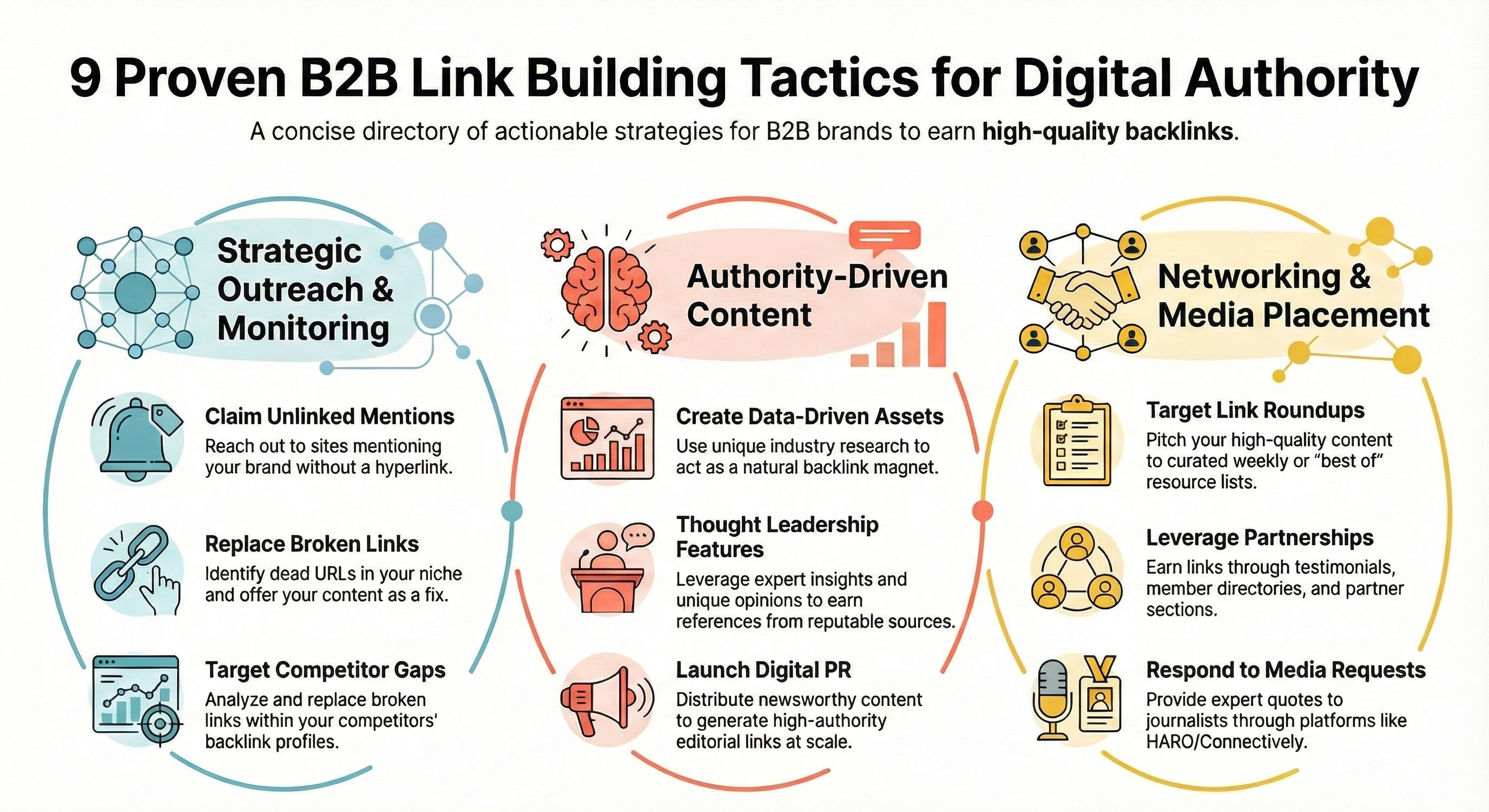
- Unlinked Brand Mentions
Brands miss out on a lot of backlinking opportunities because they don’t know where to look. There are times when websites mention your brand name without linking to your site. You can reach out to these websites and request a link to your website for the brand mention.
However, the problem is that most SEO teams don’t know how to look for brand mentions. There are a couple of ways to find unlinked brand mentions.
Method 1: Use Google Alerts
- Go to Google Alerts.
- In the search bar, enter your business name.
- Customize the alert settings so you get an alert every time your brand is mentioned.
- Click on ‘Create Alert’ to get started.
Do keep in mind that Google Alerts will only notify you of any brand mentions that will happen, not brand mentions that have already happened. So, how do you find old brand mentions that haven’t capitalized on? Check out method #2.
Method 2: Use Semrush Brand Monitoring
- For this step, you’ll need a Semrush subscription.
- Log in to your Semrush account
- Go to the “Brand” section from the left side menu.
- In the “Track Backlink” section, create a query for your brand name and include your domain name.
- Go to the “Mentions” report and apply these specific filters:
- Click on “Sentiment” and check boxes next to “Neutral,” Positive,” and “Unknown”. Don’t reach out to sites that mention your brand name negatively.
- Click on “Mention Details,” select “Backlinks,” and choose the “Without backlinks” option.
When you find a good linking opportunity, use our reachout email template, asking the website owner to add a link to the brand mention.
Template:

Subject: Want to chat about (Article Title)

Hi (Author Name/Website Editor)

I noticed that you mentioned (Your brand name) in your content (add content link here). I appreciate the shoutout.

Would you be open to adding my brand link (add link) on the brand mention? It would help your audience interact with the content and get a better understanding of the topic (specific feature/benefit you offer).

Thanks,

(Your Name)
- Broken Link Replacement Outreach
Find and replace broken backlinks and build quality backlinks on websites that are in your niche.
To find broken links, you’ll need to use Semrush again. Semrush offers a “backlink audit” tool to identify broken backlinks. Here’s a step-by-step breakdown:
- From the left-hand side panel, find “Backlink Audit.”
- Once you’re on the page, enter your domain name to start the audit.
- Switch to “Target Pages” from the top menu.
- Find “Target URL error” and check the box beside it to find broken URLs of your domain.
- From the list of URLs, find a URL that you think you may have a good replacement for. Click the number in the “Active” column to find active backlinks.
- Choose a backlink opportunity based on:
- Quality of the target page
- Nature of the content – If the content is too old, it most likely won’t be updated.
- Context of the backlink – whether the content is positive or negative for your brand.
That’s how you find broken backlinks with potential backlinking possibilities for your brand.
- Competitor Backlink Gap Strategy
If you have a competitor that has a great backlink profile, you can take advantage of it. The goal is to analyze your competitor’s backlink profile and use their broken backlinks to generate links for your brand.
If you allow a web admin to fix a link to a broken page and offer a replacement link, they’re more than likely to replace your competitor’s broken link with your live link. Replacing your competitor’s broken link and inserting your brand into a conversation where your competition was mentioned is another method to build authority.
Here’s how to find broken backlinking opportunities:
- Go to Semrush’s “Broken Analytics” tool to analyze your competitor’s domain.
- Go to the “Indexed Pages” report and check the box next to “Broken Pages.”
- You’ll find a list of pages on your competitor’s site where links don’t work properly.
- Start going through the list of broken links from the top, and find a page for which you have a good replacement.
- Click on the number next to the link to see a list of the page’s backlinks.
- Filter the list of backlinks for “Active” and “Follow” links. This way, you’ll only see links on websites that are still live and offer SEO authority.
- Analyze the quality of backlinking opportunity based on the factors we discussed above – quality, nature, and context of the link.
Here’s a sample email template to pitch for broken link building:
Subject: Opportunity to fix broken link on your page

Hi (Name)

I found that your article (add title) has a broken link on the text “(add anchor text)”.

If you’re looking for an alternative link for the “anchor text”, we have a guide (Add article link). It’s a good fit for your article (add reason). Moreover, it will improve the readability of your website as the readers will be able to find the exact content they want.

Thanks,

(Your Name)
- Link Roundups Targeting
Another way to build quality B2B links for your business is by using Roundup lists. Link roundups are curated lists of articles, resources, or blogs that are focused on a specific topic. As a brand, your goal should be to get featured on Roundup lists. Being featured on a roundup list will not only earn you a backlink but also generate traffic for your brand.
Here’s how to get started with roundup list link building:
- Search for Link Roundups in Your Niche by using specific queries, such as:
- “Keyword + Link roundup”
- “Keyword + weekly roundup”
- “Keyword + best of”
- Next, create high-quality content. Create high-quality content that is better than your competitors.
- Reach out to list curators. Once you’ve identified relevant link roundups, contact the web admins of the website and pitch your content for inclusion.
- Data-Driven Assets + Case Studies
B2B businesses have a lot of unique product data, industry insights, internal experimentation data, and research data that they can use to create data-driven digital assets. These data-driven assets & case studies can be a great backlink magnet.
This particular practice works incredibly well for established companies, personal blogs, and beginner websites. If you have something unique to share about an interesting topic in your niche, you will get tons of backlinks.
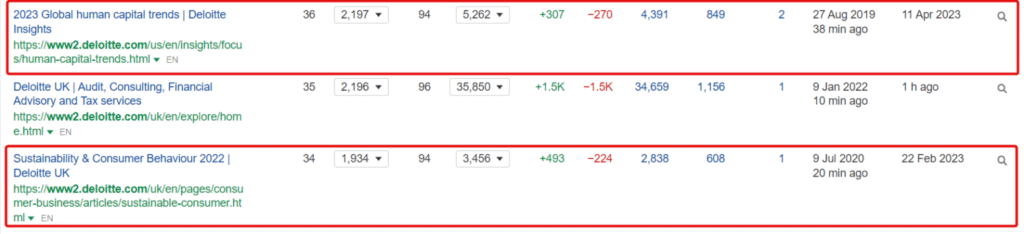
Established brands like Deloitte or Salesforce have several original research studies that lead to the highest linked pages. According to AHREFS, Deloitte’s 2 studies got them 4,131 referring domains.
- Thought Leadership Features
Why do people value an expert’s opinion so much? Because they have what the reader wants: experience and data-driven insights. If you’re able to create thought leadership content that has something truly unique to offer, then you can leverage it to earn a backlink.
There is several thought leadership content in SEO that are highly reputed, such as Kevin Indig’s blog, Rand Fishkin’s LinkedIn Post, and Tim Soulo’s articles on Ahrefs. Kevin’s blog, for example, has amassed over 4,300 referring domains. He’s earned links from some really reputable sources, such as HubSpot, Ahrefs, SearchEngineLand, Wix, YCombinator, and more.
- Digital PR
Digital PR is another great option for brands to earn backlinks. Digital PR can generate high-authority editorial links when the content is genuinely newsworthy and supported by original data. Backlinko was able to build over 5,000 backlinks in 30 days with a single article. Similarly, Buffer generated 100+ links in 14 days.
The exact number of backlinks your brand will be able to generate will depend on your brand, the type of content, and its ranking on SERPs.
- Leverage Partnerships
Another way to earn some quality backlinks is by leveraging your professional partnerships with organizations or influencers in your niche. When industry partners mention your brand and provide you with a link, it offers your brand some authority in the niche.
Here are some ways you can earn backlinks from your existing partnerships:
- Testimonials – You can write honest reviews about products and services you use in your day-to-day life. Many companies may include your brand and give a link to your website when featuring your testimonial on their website.
- Member directories – Local chamber of commerce often maintains member listings and provides websites with a backlink.
- Partner Sections – Ask your business partners, clients, or projects you’re working on to feature your website on the “Our Partners” or “Our Clients” section.
- HARO / Connectively – Media Requests
HARO is one of the oldest ways for B2B websites to earn a backlink. You can sign up on media request platforms and provide input to journalists and content creators who are looking for expert quotes, industry statistics, or commentary.
Responding to journalist requests works because your brand will be mentioned in authoritative publications on your niche-specific topics. Each mention can significantly improve the authority of your website and improve your rankings on SERPs.
What to Avoid While Building Backlinks?
Not every backlink is worth having. Poor quality backlinks may increase the number of backlinks and referring domains you have, but they will negatively impact your website’s performance. Here are some things you absolutely must avoid while building backlinks:
- Buying links
Buying links, while legal, violates Google’s spam guidelines. Buying links can result in ranking penalties. Also, think of it like this: if a website is willing to sell a link to you, they will be willing to sell the link to any other website as well. You don’t want your brand associated with a website that offers most of its links to gambling, online gaming, or any other relevant niche.
- Low-quality directories
Avoiding low-quality directories is always a good idea. Links generated from low-quality directories will not pass any authority or traffic to your website. Most of these websites are used as link farms to generate a lot of links. As a matter of fact, most search engines and algorithms consider these websites to be spammy, which can result in penalties.
- Link farms
Link farms are websites that give out backlinks to basically any website that’s willing to do a link exchange, offer money, or something else altogether. The content on these websites is poor, contains 0 informative value, and lacks authority. Google’s first helpful content update in August 2022 was aimed at getting rid of link farms that are violating Google’s spam policy. So, it’s not a good idea to get backlinks from link farms.
How to Evaluate Backlink Quality?
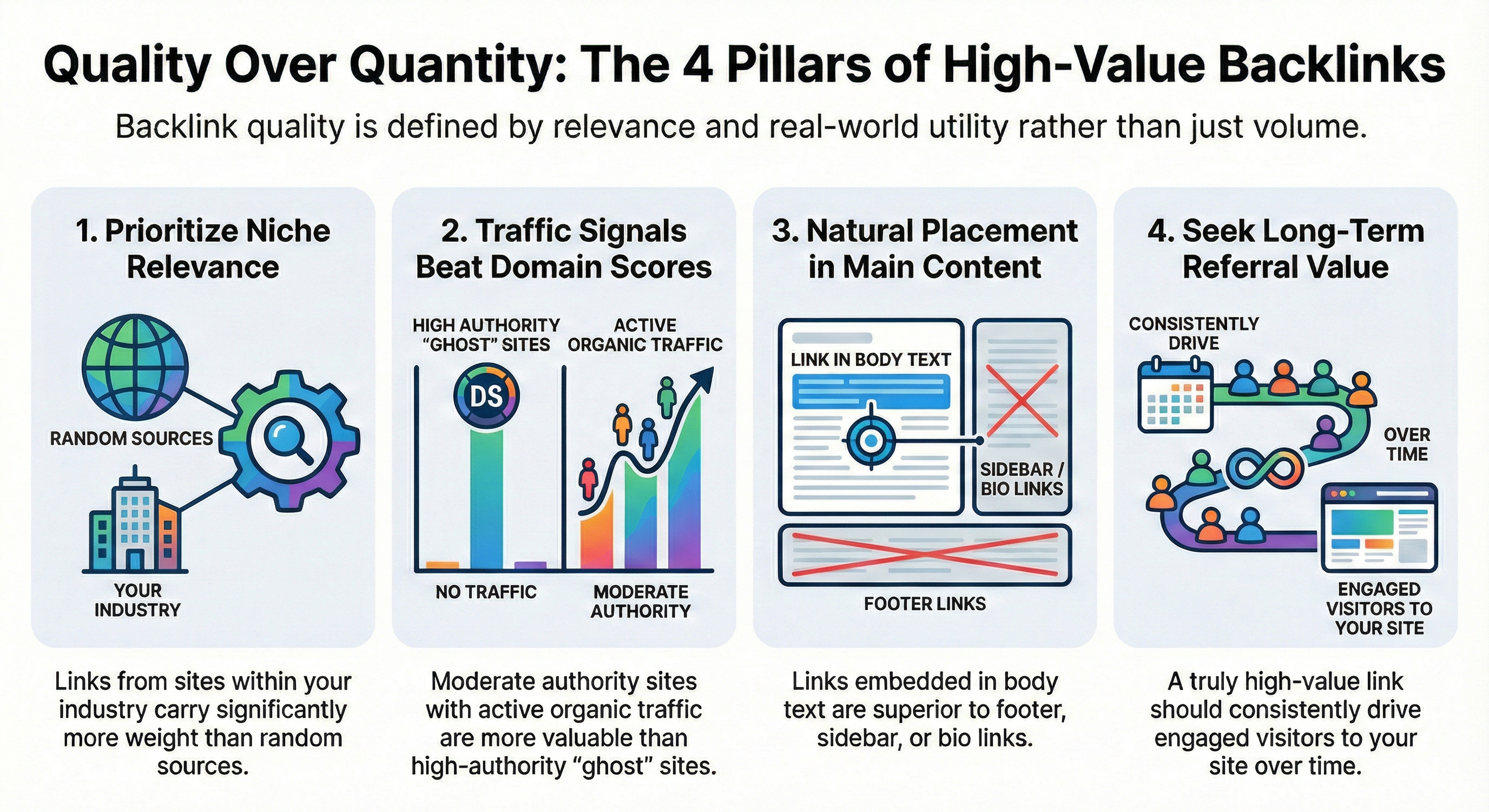
Backlink quality matters more than quantity. Here’s how you evaluate which backlinks are worth having for your brand:
- Relevance score
Relevance score is not an actual number; it’s a measurement of how relevant the link is to your brand. As a simple rule, if the linking site would never naturally reference your product or service, the link is probably low value. Getting a backlink from a website that is in the same niche as you will have more weightage than a link from a random site.
- Traffic signal vs domain score
A website that has moderate authority but consistent organic traffic offers more value than a high-domain site with low traffic. Regular traffic means that the website is trusted, active, and has good content.
- Placement & anchor context
Link placement and anchor text make a major difference in the quality of backlinks. Links that are placed naturally within the main content of a page that is relevant to your niche are better than links placed in footers, sidebars, or author bios. The anchor text should also be related to your page’s topic.
- Long-term referral value
A good backlink continues to send relevant referral traffic over time. If a link never sends traffic or engagement, its overall value is limited, regardless of authority metrics.
How to Measure Impact
The impact of links should not be measured by the count of links; there should be a focus on outcome-based signals.
Key metrics to track include:
- Organic visibility lift
As the number of backlinks increases, impressions, clicks, and ranking should increase gradually.
- Keyword ranking movement
Another sign should be the movement of keyword rankings. Keep an eye on mid-competition keywords and how they start moving after you create backlinks.
- Referral traffic
Track traffic coming directly from backlink sources. High-quality links often generate consistent referral visits.
- SERP feature impact
Backlinks can help content appear in featured snippets, People Also Ask boxes, and other SERP features, improving overall click-through rates.
Integrating Backlinks Into Your Broader SEO System
While backlinks play a major role in your Search engine optimization strategy, it’s not the only thing you should be focusing on. Backlinking works best when it works in synergy with a broader SEO system:
- Internal links strategy
Backlinks work well for your website only if they’re pointing to pages that are well-connected internally. Building backlinks for these pages allows authority (link juice) to pass across all connected pages on your website.
- Content clusters
Content clusters and pillar content can be supported by quality backlinks. If you have strong pillar pages and cluster content, you can build quality links to strengthen your brand’s topic cal authority.
- Technical SEO readiness
Having a technically sound website increases the impact of backlinks. If your website has technical issues like slow load times, crawl errors, or poor mobile performance can reduce the impact of links.
FAQs
- What makes a backlink valuable?
Several factors make a backlink valuable, such as relevance, website DA, link placement, anchor text type, and long-term referral value.
- How many backlinks do I need?
There’s no fixed number of backlinks you need. Most teams end up thinking more backlinks = more benefits. However, backlink quality matters more than quantity. Focus on backlink quality factors, rather than the number of links you can build.
- Should every link be dofollow?
No. Only focusing on do-follow links shows search engines that you’re trying to game the algorithm. Having a more natural backlink profile is the best way to generate SEO authority for your brand.
- How long before backlinks affect rankings?
Backlinks may be discovered within weeks, but measurable ranking impact typically appears over 1–3 months, depending on crawl frequency, competition, and site authority.
- What platforms provide backlink monitoring and reporting features?
The best platforms for backlink monitoring and reporting are Semrush and Ahrefs. Both offer a different set of functionalities that allow users to monitor their competition and find broken link opportunities.
- What is a toxic backlink?
A toxic backlink is another term for a poor backlink. Basically, a backlink that comes from a spammy website, a link farm, or a website that’s been penalized by Google for violating its policies. Having a lot of toxic backlinks will impact your website negatively.